The Red Pencil
The platforms changed for twenty years. The cycles didn't.
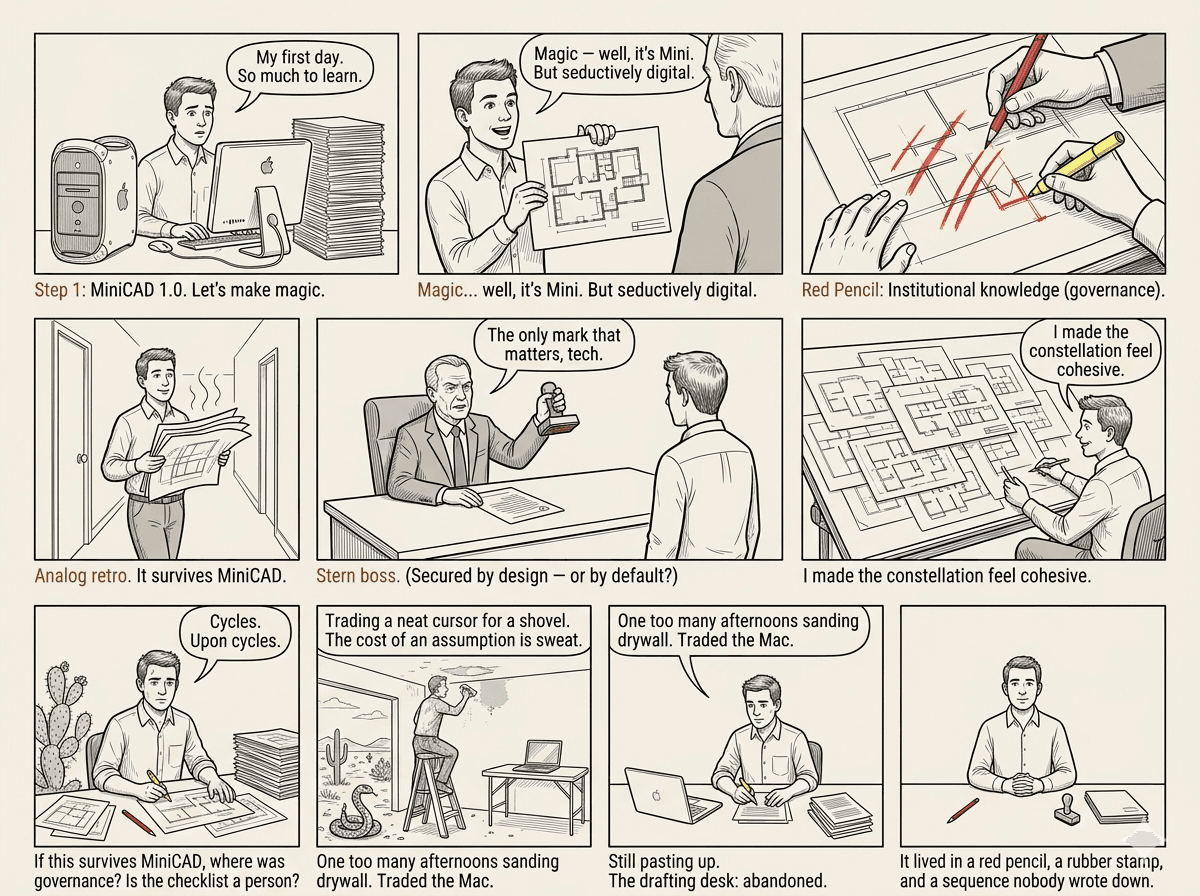
I took my first job out of architecture school because the firm used Apple computers.
That was a defiant position in the late nineties, when the PC and Windows owned the profession. Choosing the Mac as an aspiring architect came with a cost, and with a front-row seat to what would soon be called BIM. The platform was VectorWorks, freshly rebranded from MiniCAD. Who would want a CAD platform that admitted to being mini. I learned it. I taught it. I was seduced. There was magic happening inside those cathode ray tubes. The flat screen had not escaped the laptop yet.
My charge was a cycle of carports and additions. One estate was a sprawling fractalation of them: carports that morphed into additions that sprouted new carports that, you guessed it, became additions. No permits. The job was to make the constellation feel cohesive and reach a retroactive state of compliance.
Compliance. That's a good word to slow down on.
The permit counter
The office sat walking distance from the city permit counter. I would literally walk the sheets over, fresh off a proper blueprint contraption, still carrying the odor of ammonia from the bubbling jug. It does not get more analog retro than that. Where are you, hipster architects? Bring back the blueprint.
Before any sheet reached that counter, it had survived cycles of redlines. Redlining was exactly what it sounds like. The person who had accumulated the institutional knowledge imparted it through a red pencil. The mentee, that was me, soaked it up with a yellow highlighter. Don't forget to put the cap on. I can still hear it.
Cycles upon cycles. I remember asking: where is the checklist? Who knows how to do this right, so we don't rinse the redlines in yellow and repeat? Nobody handed me one. The checklist was a person.
And at the counter, the sheets carried a stamp. Stamped and signed by my cranky old boss. Weeks of my labor on those sheets, and the only mark that mattered belonged to someone else.
Looking back, I wonder where governance was.
The field
When the office got slow, I went to the field. Design-build meant boots when the drafting dried up. I remember hand-digging trenches for a gas line I assumed was in one place and discovered was nowhere near that place. Trading a neat cursor for a shovel, navigating rattlesnakes and prickly pear, made the cost of an assumption feel like sweat, tears, and sometimes blood. Ask me about waste sometime.
Same production
One too many afternoons sanding a drywall ceiling and I made a change. I traded the Mac for a Windows machine, AutoCAD Architectural Desktop, and my first flat-screen monitor. New platform. Same production. The work was still mostly 2D, with a faint hint of something 3D beyond. The routine felt like drawing with an Etch A Sketch, or as a friend put it, like drawing with light on the television.
The work product was more physical now. A literal stack of paper. Definitive. Behind the stack, a vast array of digital files with strict naming conventions, assembled under a layering standard that governed line weights.
There's that word again.
Our titles were “tech.” We had degrees, but “architect” was reserved for those who passed a series of exams. Eventually I did. Each tech took a single sheet from the set and picked up redlines, transferred the changes into the digital ether, printed the delta on a black-and-white laser printer (I can still see PC LOAD LTR), cut the drawing out with scissors, and taped it to the full-size sheet. This was called pasting up. Pasting up was the cadence of production.
The red pen stayed reserved for the person with the knowledge. The transfer still ran through the yellow highlighter. Sometimes it ran through a lunch and learn, where the knowledge arrived with an unspoken obligation to return what the lunch cost.
I changed machines. I changed platforms. I changed firms. The redlines came with me.
Three things nobody said out loud
So stand where I stood for a minute. Twenty-something, license pending, ammonia in your nose, highlighter in hand. Three things were true in that office, and nobody ever said them out loud.
The red pencil was never handed to the fastest tech, or the one who knew the software best. Someone decided who got to hold it. Who decided that? And in your organization, who holds it now, and who decided?
The stamp never carried my name, no matter whose hands produced the sheets. The output belonged to someone before the first line was drawn. Whose name does your output carry? And was that secured by design, or by default?
And the redline cycles survived everything. They survived MiniCAD and VectorWorks and AutoCAD. They survived the ammonia jug and the laser printer, the cathode ray tube and the flat screen. Every platform I traded for, the cycles came along untouched. If the cycles survive the tool, what exactly were we buying when we bought the tool?
I went looking for the magic in the cathode ray tubes because the tubes were what I could see. The thing I was actually looking for never lived there. It lived in a red pencil, a rubber stamp, and a sequence nobody wrote down.